Showing posts with label fashion. Show all posts

Saturday, January 3, 2009

Brogger's Quarterly: Five Essential Suits Under $500

Happy New Year, readers! It's internship application season. I'm assuming all you gents (sorry no suits for ladies here) will be getting past the paper-cut round and into first-round interviews. That means you need a snazzy suit to dress like you already have the job. Or maybe you need something for an occasion? Finding your suit too big? Just-want-to-looking-effing-great?

Since most of us are on a college budget, I'm going to keep these suits (jackets + pants) under $500, offer some advice on safe colors, and educate you on the different types of lapels and vents.

Still too expensive? Let's just say these suits are an investment for your life. The suits here should last you well for a couple years working, getting you the job, or being in your general wardrobe. It will pay for itself in a short amount of time.

Every guy needs a suit, and quality suits can be had for under five bills. Take a look, after the break.

Some Guidelines

1. The most common pitfall is having/buying a suit that's too big for you. Everything should conform to your body, and don't even think about "growing into it." Jacket sleeves a little too long? Pants waist need an inch more or inch less? Hem? Get it tailored.

Anything more than an inch or so in these you might wanna look at a different suit. Designers all have different cuts so don't be trapped by a particular name. They all fit slightly differently.

2. Most suits need some sort of small alteration here and there, but the chest and shoulders should fit true to size because you might as well have bought a different size suit. A tailor can tell you they can re-size the shoulder pads or reduce them. DON'T-DO-IT-LA.

3. Chest - The jacket should button up with no strain on the jacket. There should also not be too much room between the button and your chest. Try buttoning up the jacket and putting your fist in between the jacket and your chest. If there's more than a fist's worth to move around, your jacket is too big. Size down.

4. Shoulder - Shoulder pads should hug your shoulders, not protrude past them. Here's the test: Stand next to a wall. If your shoulder pads hit the wall first before you do, the jacket is too big.

5. Length - Elbows up. Side-to-side. Lean like- just kidding. Put your arms down to your sides. You should be able to cup your fingers under the suit jacket.

6. Buttons - 3? 2? 1? Up to you. A 3-button is the traditional classic look. You can't go wrong with it. To modernize the 3-button suit, some designers go for the 3-roll-2 look where the lapel rolls over the 3rd button, so you just button the middle one.

The 2-button is the most modern popular suit you may see on the racks right now. It used to be the conservative choice for people working in the government, but now all the hip designers are modernizing it with slimmer cuts and streamlining the look so its a hip-cool outfit to wear anywhere.

1 button? If you can pull it off, go for it. It's super sleek and chic. It's not for everyone, but if you got the body and looks to go for it, well, go for it.

One of my best friends, Nehal, actually has a 4-button suit. Quite interesting (that's not him, but his suit does look like that).

7. Lapels - Notch lapels are what you see most of the time. Always safe. Peak lapels are something out of the old-school book. It's kinda sophisticated and polished. It's making a comeback in the high-fashion realm so take your pick.

8. Vents - A center vent is the all-purpose and traditional one you see. Side-vents are popular with European designers. They make you look a little more streamlined and sleek because it can cut away any unwanted curves you may be having in the waist area.

Okay, you're ready to read on.

To preface the suits, these are full retail prices listed. When you go shopping during sale season, these drop like crazy. You can have these suits for 40-50% off retail so they're gonna be even cheaper.

The Gray Suit
$378, by Club Monaco

Let's consider the gray suit as your foundation to a suit wardrobe. It's always appropriate for either for an interview or a day on the job.

The opinion out there is sometimes the gray suit is the most boring, old-man color of suits. It's all about the fit.

It's versatile to pair with white, blue, pink, and just about any other color because it's a neutral tone. It will be easy to throw together something that you don't have to worry about.

While this suit does just fine, I'd actually recommend a more medium-gray shade like the one seen here to fit more in line with a business environment.


The Navy Suit


$443, by Banana Republic

Looks like it's black, but it's just a very dark navy blue. This is another safe classic suit color. It works particularly well if you have to transition from work to dinner because it lends itself to be a snazzy evening outfit too.

Again the outfit is pretty versatile in terms of shirt-tie combo, but if you wanna go for a sleek look, pair it with a white shirt and a dark tie for a sure winner.

The Navy Pin-stripe Suit


$250, by H&M

The navy pin-stripe is the cool man's suit. There's a level of confidence that goes along with wearing one. Big boss guys, bankers, hot-shots, etc will sport a pin-stripe suit. You mean business when you wear this.

The normal shirt-tie combo with a pinstripe is solid shirt solid tie. If you want to be adventurous, you can go for a striped shirt or striped tie, but not both. It'll look too busy with all the lines happening. Just make sure all the colors are similar and the stripes don't match. You'll want something bold to contrast the pin-stripes on the suit, not go with it. See, matching isn't so in with everything.

The Black Suit

$256, by Calvin Klein

This is probably the suit you own right now. The only one.

Look, the black suit is all good and dandy, but I don't think you have that many black-tie events, formals, or funerals to go to.

So why do people usually only have black suits? Probably because you don't know what else to get, and it's a "safe" color. It "goes with everything."

I'd have enough money to buy a suit if I had a dollar for every black suit I saw at a career fair or interview. Look broski, there's nothing to mourn at the career fair except maybe for your poor choice of clothing and failure to get a job.

Just kidding. I'm really not that mean. Really. Comon, that's just being super shallow.

When you wear a black suit, don't make it look like you're wearing it just for the black suit else someone is going to mistake you for going to a formal event or a funeral. So, go for a colored shirt. Blue, pink, purple, whatever. A patterned tie works too. You'll just want to dress down the look a bit if a black suit is all you got and have to work with it.

The black suit is versatile too, no joke. You or your parents bought it for you so you can wear it, not just with a shirt and tie. Refer to the picture. Just don't expect to show up to the corporate environment wearing something like this though.

Of course, there's the flipside to the black suit. You better look damn fine going to your formal event or whatever demands you.

The Khaki Suit
$250, by Express

With all these dark shades of suits, you'd be wondering what to wear on a warmer day. The khaki suit is acceptable to wear to work if you need to complete your suit wardrobe.

Match it with a dark tie to contrast the suit. After work, take off the tie and you're already dressed for going out in a great outfit.

I don't have the mentality to wear a khaki suit yet, just because I don't wear suits enough yet to feel a need for one. For me, this would probably be the last addition to my wardrobe after the rest of them.

I guess if I was a baller going on a business trip to a warm place or vacationing in an elite area I'd pick up one of these ($376 French Connection).

So there we go. Suits ain't so expensive if you wanna look great. I got my suit at Nordstrom Rack's sale for 60% off. Original price $1100, copped for $400. That means you can get these suits for even cheaper. Good luck hunting! Hit me up for more tips or if you want me to go suit shopping with you!
Read More......

Saturday, December 6, 2008

Brogger's Quarterly: Raw Denim

These jeans are all from the same French label APC. They are called the New Standard. Now, what's so special about them?

They're in a unique division of denim: raw.

Most of the mainstream are unaware of these raw jean shenanigans. However, to the fashion-conscious, raw denim has a cult following, especially in Japan, where a fine pair of Japanese jeans is the single most valuable item of clothing in a closet. Raw is also synonymous with "dry" for some brands.

You're probably familiar with the term washed denim because you see different "washes" whether it may be called "stone", "sunset", or whatever depending on the brand. So that's exactly it, actually. You already know half the story. Full denim nerd-erature ahead.

The normal jeans you see day-to-day are washed jeans. They come in a washed color, fit-true-to-size, and more or less never shrink. They made fade over time if you wash them 3-4 times a month but it's very slight in most cases. Also, they feel pretty normal as to how denim feels. Rugged, perhaps somewhat soft. Most commercial mainstream jeans are "distressed" to have a certain look, color, softness, and are pre-shrunk in the process.

Dark jeans gradually became the craze for going out at night or for a slim-fitting look. Back in the day (and I mean like probably within the last decade only) people did not used to wash their "dark wash" jeans was because it would gradually turn lighter and lighter, but due to engineering these days dark washes stay dark no matter how much you wash them. Awesome!

So what does this have to do with raw denim? Think opposites.

Raw jeans are made from raw denim - unwashed and untouched straight out of a loom. Denim, as it is manufactured, has a dark shade of indigo (dark blue dye) unless it's black denim.

The result of this is a very nice dark pair of jeans, but due to being unwashed it is very stiff. It's stiffer than you expect due to the starch and/or resin that was used to manufacture the material. On the plus side it gives it a sheen/shine that you don't see in washed denim. However, because it is also unwashed, the indigo will bleed off easily and lose color with washing.

By the way, they don't fit true to size either, completely. Most raw jeans are 100% cotton denim, meaning they will shrink in the waist and inseam when washed. Some brands have chosen to incorporate 2-3% spandex to help the fabric stretch and retain it's shape, but there is still some shrinking involved.

Raw denim jeans sounds pretty terrible by now, right? They're stiff and uncomfortable, don't fit true to size, shrink, and bleed color. Why would I even want these?

Take a look at the picture at the top again. I'm going tell you again they're the same model from the same brand.

What if I told you they're all actually the exact same jean?

The beauty of raw denim lies in the uniqueness of its wash - your own.

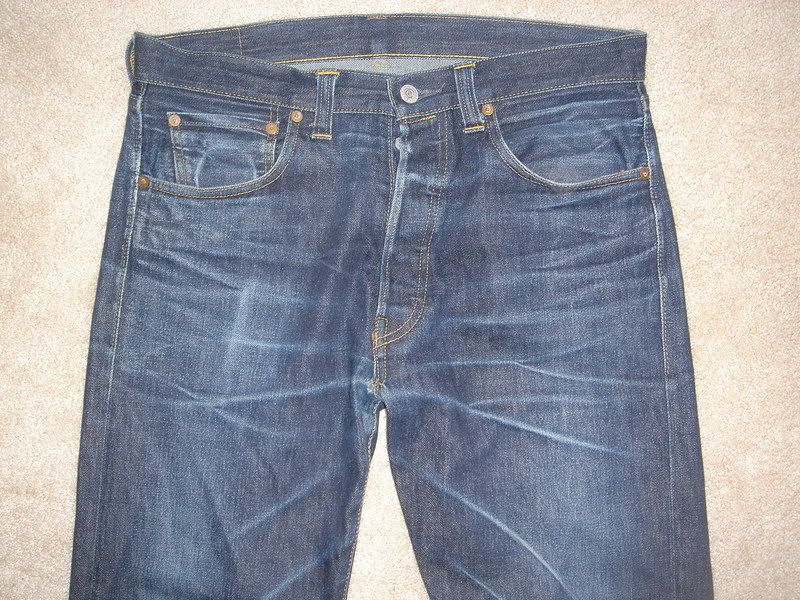
Because raw denim is unwashed, it will conform to your body shape and fade based on your body, how much you wear the jeans, what you do in them, and how often you wash them. The color and fading depends on you, and you can truly call them your own because no one else in the world will have the exact same wash.

This is probably expensive, right? Nope. It's actually cheaper than buying "premium" washed denim.

Brand Porn - Ready, Set, Go!

$30 - Levis 501 regular-rise straight leg STF's (Shrink-to-Fits) @ any department store
$35 - Uniqlo slim-fit raws except there's no Uniqlo on the west coast.
$40 - H&M Sliq slim-fit raws
$50 - BDG slim-fit raws @ Urban Outfitters
$60 - Cheap Monday slim-fit raws @ Urban Outfitters / department stores
$80 - Gap low-rise straight-leg 1969 model
$100+ - too many, but recommendations are APC, Nudies, and Levi's LVC if you want to keep within a reasonable price range. Japanese imports upwards of $150+

Denim Terminology and Nerd-erature

Selvage
- Take a good look at this over-sized picture. Selvage denim is basically a special type of denim that has stitched edges on the outseam (so on the inside of the leg, confusing huh?) to prevent unraveling or ripping. Back in the day of clothes-making, fabrics would get moved around alot and the edges would get messed up. Selvage edge looms were made to prevent unraveling from the edges. Pretty cool. Selvage denim jeans usually denotes a higher quality of denim because they are cut from these vintage looms.
Hige - Pronounced "hee-gay." Hige or whiskering (you see why?) are lines of fading and also the fading that occurs around the crotch and thigh area. The picture above demonstrates it really well. These lines form by continual creasing of your legs moving when you walk, sit, cross your leg, etc. This is the area that will usually fade first.
Atari - Wait, the video game system? No, it's the lines and fading formed by the creasing of fabric due to pressure exerted on it. Above you can see cases of where atari can occur behind your knees where you bend your legs. It can also happen down near your legs if you are wearing a slim-fit jeans and extra fabric bundles up at the bottom.

Before & After Wash - The Wrap-up
Jean: Levi's LVC 1947 501's
Left: 5 months wear
Right: 20 minute soak in cold water

With only a soak in cold water, not even a wash, you can see a color difference. There's more defined fading in the thigh area and the jeans look lighter overall. If this had gone through a warm wash and a tumble dry in the dryer, you would see more drastic fading, but lose the dark color.

Still interested in being a denimhead? Head over to superfuture: superdenim where you can read up on all things denim and take a look more at the raw denim culture.

Give raw a try! It's not really a hassle if you think of them just as any other pair of jeans you wear, and it's neat making your own wash of jeans. Lot's of people get fed up with the whole maintenance and technicalities of taking care of them.

My advice? Wear them like any other pair of jeans. Don't treat them special in case you "mess them up" or anything. It'll give your raw jeans some character when you finally do soak or wash it. My current pair of raws is going 2 years with 4 washes.

Pictures are courtesy of superfuture:superdenim users.
Read More......

Thursday, November 27, 2008

Brogger's Quarterly: 'Tis The Season

Winter is the season where you see certain patterns worn more than any other time of the year. It's not to say you can't wear these on a normal basis year-round, you definitely can. For some reason, certain patterns are more appropriate for the holiday season. I love it.

The colors of red, green, and everything in between really inspires the holiday spirit for me, and I figured I'd introduce the readers to some popular winter patterns and fabric as well as clarify some common terms.

What's the difference between plaid, flannel, and tartan? The answer, tips, and more - after the break.

Plaid VS Flannel VS Tartan

Can you tell the difference? Well, you shouldn't be able to, and I know I can't. Why?

The terms seem to be interchangeable due to etymology, pop-culture, and definition. Let's clear this up.

Here's a fabric/pattern lesson:

Plaid refers to the cloth itself, not the fabric. It's the actual piece of cloth you wear. The pattern just happens to be in the familiar check pattern because it's originally a Scottish term. A "full plaid" refers to the piece of cloth wrapped around the shoulder and fastened in front and worn with a kilt (bagpipes included).

Flannel is a soft woven fabric, spun from wool or cotton. We see it as a check pattern the most because it was made famous in the 90's by rock music. It was a hit with grunge and alternative rock musicians and listeners. Smells like teen spirit, right?

Tartan is the actual term used to refer to the criss-cross pattern you see in most plaid and flannel. It's woven horizontally and vertically with multiple colors. Tartan is most associated with Scotland because kilts usually use the pattern, but through some American English translation of tartan, most of us just call it plaid. So the term "plaid shirt" is correct in most cases because the shirt is made out of cloth, but if you wanted to describe the pattern tartan is more accurate. Meh, whatever.

So, technically, the picture above could be plaid or flannel, but they all have a tartan pattern.

Other Patterns

Argyle is a holiday favorite. To the eyes' illusion, it looks like a bunch of diamonds. If you tilt your head, you can actually see it's just a diagonal checkerboard.

Personally I like the size of the argyle you see the on the left. Sometimes I see patterns that are too small (so many diamonds) that it's too busy or too large (one or two huge diamonds) that look gaudy.

Argyle sweaters and vests are sure-shot winner.


Fair Isle is a little more obscure. You might have seen this eclectic design before, but not really know what to think of it. It seems a little too busy and random in the designs at first glance.

The Fair Isle design originates from... Fair Isle, a tiny island north of Scotland. Wah-wah-weh-wah!

It describes a technique in which you alternate weaving different colors together. Designs tend to repeat themselves in different lines down the pattern.

While it may look busy, it has an old-world traditional feeling to it. Kinda like how cardigans used to be grandpa-styled and now they're super fit-cut and cool for hip kids, Fair Isle designs can also be "cool" and "with it" okay?

Left to right: mini-gingham, gingham, tattersall

Gingham originally was woven as a stripe pattern, but since the English started making it, it's been woven into a check pattern. Something about those United Kingdom countries making lots of check patterns...

Tattersall is a check pattern of horizontal and vertical stripes of two colors on a lighter background. Makes for a good spring shirt too.


You can differentiate gingham and tartan because the check pattern of gingham is just around two or three colors. Tartan is multi-color with interweaving horizontal and vertical layer of color. See the difference even though the color scheme is similar?

How to pull it off

Keep it simple. Since wearing one of these patterns is already a statement in itself, keep your other clothes fairly simple and solid colored. We don't want to mix all these patterns together.

It's about the contrast. Pair a patterned shirt with jeans and a solid color scarf for a simple classic look. What if you only have solid color clothes? No problem, pick yourself a patterned scarf. That burst of color among your solid clothes will stand out.

Oh, and there's no reason why this all doesn't look good on women either.

Happy Thanksgiving, and cheers.
Read More......

Thursday, November 20, 2008

Broggers Quarterly: The Fit Guide to Shirts

Any piece of clothing you are considering buying should fit you. Many people size up for the sake of comfort, but clothes can be comfortable and look good on you too. I always see shirts that are too big for a guy, but I don't think most people are going for the Urban gangster look on campus... Here's a quick-guide to how shirts should fit your body:

First, check the length of the shirt. A button-up dress shirt is cut longer than a casual button-up shirt so make sure what you're looking for is what you want. Here's the difference of what it looks like when you wear a dress shirt casually the wrong way and a casual button-up the right way.
Very good, gypsy. I will look at your treasures. In the first picture, you can see the shirt drops down to where the pants leg separate into two. This shirt is too long to be worn untucked. On the right side, you can see the length difference. An untucked button-up shirt should drop right past the waist to avoid a baggy or over-sized look.

If something feels too tight, do the "I'm an airplane" trick. Arms straight up. Arms side to side. Wave arms in circles. Whooooosh. I guess this might be a better example: If you can't fully extend any part of your body and move around comfortably enough to run around - it's too small. Although, if you have fabric bunching up at your arm, shoulders, and the shirt is poofing outwards when you tuck it in - it's too big. Everything should fit comfortably flush with your body so you can show it off.

Sleeves should reach your wrist bone and should have no excess fabric bunching up near it or on the sides. The shirt should run flush with your arm and hug your shoulders. No poofing either on the sides for tucked-in shirts. Walk around to see if it poofs with movement or with your arms raised. The picture on the left shows both excess sleeve material and poofiness from the sides. On the right, we can see how it's showing off his figure because of the right fit. Sexytime.

What about short sleeved shirts and polos? The same applies, but now you don't have any sleeves to worry about! Yay one less thing to consider.

When considering a button-up short sleeve, make sure it just fits your body. Before you even button-up the shirt, pull the two sides past each other - how much room is there? If you can pull one side of the shirt past the buttons, consider sizing down. It should reach flush with your body when buttoning up. Alternatively, you could button-up the shirt and see if you can fit a fist through your shirt from the top - it's too big if you have successfully Over-9000-Gundam-punched through it.

For polos, have it sit just past your waist. The sleeves should be right between your elbow and shoulder, so you can partially show off those guns of yours. You can see this in the two pictures above.

Next time I'll write about shirts in more detail, but for now, go find a shirt that fits you. (photos courtesy of GQ and JCrew) Read More......

Friday, November 7, 2008

Broggers Quarterly: Lace-Ups Follow-Up

I've received some questions regarding how the lace-ups would look for casual occasions, since they more or less work for business casual to business wear. This is how you would go about wearing them on a night out in the city or at a nice restaurant. Some looks, ahead:

The Plain Toe: Worn with corduroy pants

The Wingtip: Worn with dark blue selvage jeans

The Cap-Toe: Worn with black jeans Read More......

Thursday, November 6, 2008

Broggers Quarterly: Lace-Ups

Let's get this straight. I'm no professional or snobby style guy to tell you what to wear, but I can at least let you know how to tell shoes apart when you're looking for a nice pair. As part of a mini-series on shoes, I'll start with lace-ups.

Every guy should own a nice pair of lace-ups. Sooner or later you're gonna have to either go to an interview, work in a professional environment, or go on a date somewhere nice. In the case your interview and work environment are casual, I hope you are planning to go on a date sometime in your life.

Don't be fooled by how these shoes suggest a world of "uncomfortable." Either the shoes are of poor quality material and construction (in which case you should look for another pair), or you are getting the wrong size. By now, your feet have stopped growing, and you should know your size. Shoe salespeople aren't just there to hand you boxes. Don't be embarrassed to tell those d-bags to measure your feet if you don't know your size. Different brands may run in slightly different sizes, but expect to be within half a size correct.

Small shoes obviously hurt your feet in the long run. Big shoes make you feel and look like you're a clown, walking around like you have some cramp in your leg. You're gonna walk and be in these for a long time so you better make sure you're comfortable in them. Don't sacrifice looks for comfort. A good pair of shoes will have both.

Sometimes people say they notice your shoes before actually noticing you. I guess you might be looking down at the floor if you're shy and can't look someone in the face.

Or if you're drunk and on the floor.

Lace-Ups (thanks for the pix, GQ)

The Plain Toe: Classic, sleek, no frills. Minimal details means keeping it simple and classy. Dress it up for business wear or dress it down with chinos or jeans. It's a versatile shoe that looks nice without being too formal, but it can be at the same time. Let's stay away from the square-toed ones, though. Unless you like looking like a clown, stick to rounded tips like the one above.


The Wingtip: Versatile? Yes. The stitching gives way for a more casual look, but it can be seen in the office at times. Verdict? Wingtips can be seen in both a casual and corporate setting. In a casual sense, pair them with chinos and jeans on a night out. Wingtips are popular with professionals also because they show that they mean business, but you can wear them casually to mean business as well.

The Cap-Toe: Suit up, my friend. Business casual, at least please. The cap-toe is a common workhorse in the professional environment and for good reason. Ever seen steel-toed boots? Well, this takes a number from that and makes it stylish. The addition of the simple line stitch across the top is to remind you that you're the boss.

The Moc-Toe: Dubbed so because of the stitching that imitates the line of the shoe. Moc toes are what you would say, "srs bizness." I've only seen these worn with suits if not tuxedos. They do look a little out of place when worn casually given the design of them. I'll save these for my future career path and formal occasions. The only time I wore a pair of these was when I was performing in a concert for my orchestra. Yeah, I won't be in these any time soon.

Stay tuned for more next week. Read More......