
- Liar's Poker: Written by a current Berkeley resident, Michael Lewis, this recounts the rise and fall of Salomon Brothers, an investment bank whose heyday was in the 1980's. The man wrote the book to try to expose the utter absurdity and childishness of working on Wall Street, but it drove college students to the investment banking industry like no other. I spoke with an Executive Director in Fixed Income at Morgan Stanley who quoted this book as his reason for joining the industry. Funny how things work out...
- Reminiscences of a Stock Operator: Released in 1923 (not a typo), the lessons of this book remain relevant to this day. Before the modern computer was even thought of by Alan Turing, the markets were completely manual, recorded with pen and paper, but speculative trading was in full force in the 1920's, with little regulation and obscene amounts of leverage (2x leverage is maximum for retail investors today, 10x leverage was not uncommon then). I haven't read this book, but it's on the list.
- The Black Swan: This book, by Nicholas Nassim Taleb, was released in 2007 and partially "predicted" the market crash of 2008. Taleb argues that we cannot predict anything other than what color socks we wear in the morning, we falsely believe anything said by an analyst in a suit, and other sorts of logical fallacies. This book gives you a lot to think about, and it's material is applicable to more than financial forecasting. One of my statistics professors delivers a good PhD-esque analysis of the book, and while he agrees with many factors, there are also plenty of logical fallacies in Taleb's arguments.
- The New Market Wizards: As stupid as this sounds, this book contains direct transcriptions of the author's interviews with some of the most successful, seasoned investors on the planet. I read the old 1980's version, though the investing and speculating tips inside are timeless. However, I think this guy has a bent towards futures and commodities traders, which ain't really my gig. Perhaps this has changed in the more recent revision.
- Intelligent Investor: Written by Benjamin Graham, this book is the canonical text on value investing. Well, I lied, the true canon of value investing is Security Analysis, but that's a 1000 page textbook meant for graduate students in finance or MBA programs. Intelligent Investor is meant to provide broad guidelines for average human beings trying to maximize the return on their savings. I think this should be a required read for anybody who is going to trade stocks. This book was originally released in 1949, further proving that true investment know-how is timeless.
Showing posts with label finance. Show all posts
Showing posts with label finance. Show all posts
Tuesday, July 28, 2009
List: Finance reading
So you wanna be the next BSD at a bulge bracket bank? (or are boutiques the new bulge bracket?) Want to avoid becoming equities in Dallas? Are you a straight-shot to being the youngest M&A MD the world has ever seen? You better start reading these books now, as they are a small fraction of the legendary books read by everyone in the financial services.

Sunday, June 28, 2009
Retail bankers
An NYU girl (A Stern business major) was sharing various NYC nightlife stories with me when we were at the bar. This was by far the best one. And if you don't get it, you're part of the joke.
- "So this guy at the bar started talking to us. He thought we were just stupid dressed-up girls, so he tried his best 2007-era pick-up line. 'I work at a bank.' My friend and I give each other that look where we tacitly agree that he's a douchebag, we but decide to humor him.
'Oh wow, so where do you work?'
'Wachovia.'
'....BWAHAHAHAHAHHAAH, OKAY RETAIL BANKER'"
Friday, January 2, 2009
Long TBT, short Treasuries
I made my first trade today, and I will note that this is more of a speculation than an investment.
TBT is the symbol for "PROSHARES ULTRASHORT LEHMAN 20 PLUS YEAR TREASURY".

UPDATE: This article popped up a couple hours after my trade :-D
TREASURIES-US 30-year bond trades over 3 points lower in price
UPDATE: This article (Cover story of Barron's), which came out the day after I bought this ETF, is about the bubble in US Treasuries.
Get Out Now!
Here's a deconstruction of what this is:
When an institution wants to invest its capital in the safest possible securities, they go to Treasuries. The United States Treasury is rated AAA and it is pretty much assumed that there is no possible way that the United States could default on its debt [Note: Some day this might not be true. If it happens, it will be far worse than anything that has happened to date]. So as the stock markets crumble, corporate defaults rise, homeowners default on their homes, and consumer spending declines, the safest place to put your money is in Treasuries.
However, Treasuries are bonds, and therefore they have interest rates. The 'yield' is the interest rate that equates the present price of the bond with the sum of the discounted future value of the bond as it pays out to whoever owns it (There are subtleties that I will not go into). There is an inverse relationship between yield and price. As price of the bond goes up, the yield decreases. However, yield (theoretically) should not go below zero. If the yield was below zero, that would mean you would purchase a bond at $100, and when it pays you back once it matures, you get paid back less than $100. That's not the way it's supposed to work.
However, the demand for Treasuries has been far higher than anyone has ever expected. The shortest-maturity T-bills are 3-months, and their yield is now around 0%, and in intraday trading it has supposedly even gone negative. This is because their price has been bid higher and higher as more and more investors move towards safe assets. These low interest rates are unprecedented, and my opinion is that it is not possible for these yields to go much lower. If yields can't go lower, that means prices can't get any higher, so I'm shorting the Treasuries on the bet that prices for Treasuries can't go anywhere but DOWN from here. In trading-speak, there's no upside risk to Treasury prices because yields can't really decrease from here. The US government paying 2.8% for a 30-year loan? I don't think so...
Read More......
TBT is the symbol for "PROSHARES ULTRASHORT LEHMAN 20 PLUS YEAR TREASURY".

UPDATE: This article popped up a couple hours after my trade :-D
TREASURIES-US 30-year bond trades over 3 points lower in price
UPDATE: This article (Cover story of Barron's), which came out the day after I bought this ETF, is about the bubble in US Treasuries.
Get Out Now!
Here's a deconstruction of what this is:
- Proshares: Proshares is the company that manages the various index funds
- Ultrashort: This ETF is 2x short the index that it follows, meaning that a 1% drop in the index results in this ETF rising 2%
- Lehman 20+ Year Treasury: The index that this ETF tracks is the Lehman index that tracks the price of US Treasury Bonds that have a maturity of over 20 years
When an institution wants to invest its capital in the safest possible securities, they go to Treasuries. The United States Treasury is rated AAA and it is pretty much assumed that there is no possible way that the United States could default on its debt [Note: Some day this might not be true. If it happens, it will be far worse than anything that has happened to date]. So as the stock markets crumble, corporate defaults rise, homeowners default on their homes, and consumer spending declines, the safest place to put your money is in Treasuries.
However, Treasuries are bonds, and therefore they have interest rates. The 'yield' is the interest rate that equates the present price of the bond with the sum of the discounted future value of the bond as it pays out to whoever owns it (There are subtleties that I will not go into). There is an inverse relationship between yield and price. As price of the bond goes up, the yield decreases. However, yield (theoretically) should not go below zero. If the yield was below zero, that would mean you would purchase a bond at $100, and when it pays you back once it matures, you get paid back less than $100. That's not the way it's supposed to work.
However, the demand for Treasuries has been far higher than anyone has ever expected. The shortest-maturity T-bills are 3-months, and their yield is now around 0%, and in intraday trading it has supposedly even gone negative. This is because their price has been bid higher and higher as more and more investors move towards safe assets. These low interest rates are unprecedented, and my opinion is that it is not possible for these yields to go much lower. If yields can't go lower, that means prices can't get any higher, so I'm shorting the Treasuries on the bet that prices for Treasuries can't go anywhere but DOWN from here. In trading-speak, there's no upside risk to Treasury prices because yields can't really decrease from here. The US government paying 2.8% for a 30-year loan? I don't think so...
Read More......
Monday, November 10, 2008
Credit default swaps and novation requests
I am going to do my best tonight to procrastinate and generally not do work , so I figured I would school you gentlemen (and whoever else reads this tomfoolery) on something I'll bet you've heard of if you've followed the Wall Street meltdown.
Imagine you buy $100 million in 10-year bonds from Google. The buyer of a bond is said to take on "credit risk,", the risk that the borrower cannot pay off bond in a timely manner.
You (the buyer) decide to call up Goldman Sach's and ask for insurance on $100 million notional of GOOG 10-year bonds in order to protect yourself from losing money on a (potential) Google default. Some number crunching is done by the quants, and they give you some percentage, say, 100 basis points (100 basis points == 1 percent). This means that every year that Goldman provides insurance against Google defaulting on their debt, you pay them .0100 * $100 million = $1 million per year.
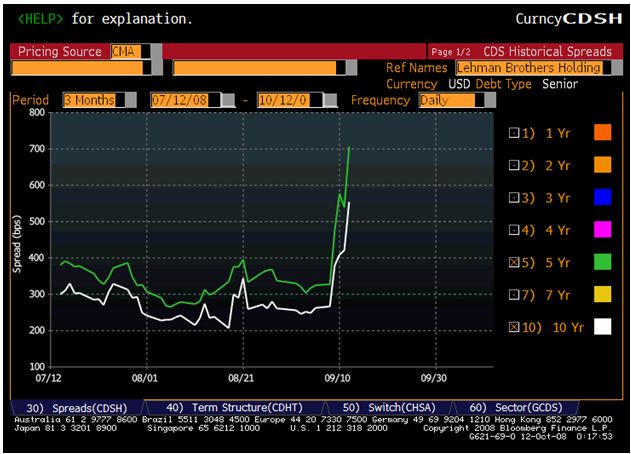
Now, that 'insurance' you just bought is actually called a credit default swap. You pay them for taking on Google credit risk, and they pay you back if Google defaults. When the price of a credit default swap increases, that means that people are betting that a company has higher likelihood of collapsing. Here's a chart of Lehman CDS right up to their bankruptcy.

So now let's say that Google goes bankrupt because it hires too many young, inexperienced programmers from Stanford, and it defaults on its debt. Let's say their bonds drop in price to $0.20 on the dollar, which means that people expect that only 20 percent of the value of the bond will be recovered in bankruptcy court. Had you not bought the CDS, you would be out $80 million. But because you were paying GS for the insurance on the debt, they pay you the difference between what you paid, and what the bond is currently worth. In this case, they pay you $80 million, and you have no net loss.
Here's another hypothetical situation: Let's say you're quite sophisticated, and decide to sell a CDS to Morgan Stanley on $100MM 10-year GOOG bonds. Since you've both bought and sold an identical CDS, your position nets out to zero. Here's why: If GS pays you $80MM because of a Google default, you would have to pay the exact same amount to MS because you're providing them insurance on the same default.
But here's the new novelty: What if YOUR firm goes bankrupt? What happens to GS when you can't pay the $1MM premium? And what about MS paying for protection on the GOOG debt? They're paying you for nothing?
This is precisely what happened to Lehman and Bear Stearns: nobody knew what would happen to their CDS trades. What resulted was "novation requests", where buyers and sellers of CDS would try to find offsetting trades (such as the one above) and eliminate the guy in the middle. In our example, GS and MS would eliminate YOU as the counterparty in the middle and deal directly with each other. The first ever Sunday trading session occurred so that traders could match trades and issue novation requests to eliminate Lehman from the middle of CDS trades.
Don't you love derivatives? Warren Buffet calls them "financial weapons of mass destruction" Read More......
Imagine you buy $100 million in 10-year bonds from Google. The buyer of a bond is said to take on "credit risk,", the risk that the borrower cannot pay off bond in a timely manner.
You (the buyer) decide to call up Goldman Sach's and ask for insurance on $100 million notional of GOOG 10-year bonds in order to protect yourself from losing money on a (potential) Google default. Some number crunching is done by the quants, and they give you some percentage, say, 100 basis points (100 basis points == 1 percent). This means that every year that Goldman provides insurance against Google defaulting on their debt, you pay them .0100 * $100 million = $1 million per year.
Now, that 'insurance' you just bought is actually called a credit default swap. You pay them for taking on Google credit risk, and they pay you back if Google defaults. When the price of a credit default swap increases, that means that people are betting that a company has higher likelihood of collapsing. Here's a chart of Lehman CDS right up to their bankruptcy.
So now let's say that Google goes bankrupt because it hires too many young, inexperienced programmers from Stanford, and it defaults on its debt. Let's say their bonds drop in price to $0.20 on the dollar, which means that people expect that only 20 percent of the value of the bond will be recovered in bankruptcy court. Had you not bought the CDS, you would be out $80 million. But because you were paying GS for the insurance on the debt, they pay you the difference between what you paid, and what the bond is currently worth. In this case, they pay you $80 million, and you have no net loss.
Here's another hypothetical situation: Let's say you're quite sophisticated, and decide to sell a CDS to Morgan Stanley on $100MM 10-year GOOG bonds. Since you've both bought and sold an identical CDS, your position nets out to zero. Here's why: If GS pays you $80MM because of a Google default, you would have to pay the exact same amount to MS because you're providing them insurance on the same default.
But here's the new novelty: What if YOUR firm goes bankrupt? What happens to GS when you can't pay the $1MM premium? And what about MS paying for protection on the GOOG debt? They're paying you for nothing?
This is precisely what happened to Lehman and Bear Stearns: nobody knew what would happen to their CDS trades. What resulted was "novation requests", where buyers and sellers of CDS would try to find offsetting trades (such as the one above) and eliminate the guy in the middle. In our example, GS and MS would eliminate YOU as the counterparty in the middle and deal directly with each other. The first ever Sunday trading session occurred so that traders could match trades and issue novation requests to eliminate Lehman from the middle of CDS trades.
Don't you love derivatives? Warren Buffet calls them "financial weapons of mass destruction" Read More......
Thursday, November 6, 2008
The Bear-Market Rally: Demystified
In case you haven't been paying attention, the stock market has had some interesting action lately. Though I didn't have the guts to actually put my money where my mouth is, I think this perfectly exemplifies the notion of contrarian trading (where you bet that the collective market wisdom is wrong). I'm going to try to keep this simple and explain it in pictures:
Here's a chart of two months of trading. The Dow drops 29% in this period. Thing's ain't looking too good.

Now look at the six trading days following the market bottom on October 27. The bailout is working! The capital infusions are strengthening our good banks! The recession is over! That's what the press wants you to think...There was very little bad news in the newspapers that I was aware of, and I'm sure there were people thinking to themselves "The stock market is a leading indicator of our economy, now that it's going up, it must mean that we're out of a recession! I mean, we've already been in it for 10 months or so and the average recession is only 11 months long, so it's gotta be over soon." The market rallies 18%.

Now look at the past two days:
 The market drops 10% in TWO DAYS! The volatility is incredible, in Intelligent Investor, Benjamin Graham (the mentor to Warren Buffett) claims that average price appreciation on equities is about 4% a YEAR! Yes, when you smooth things out over ~250 trading days a year, it's reasonable, but the market swings taking place today are a few-times-a-century phenomenon. I put cash in my brokerage account so that I could buy-in once the two-week rally crashed. We'll see if tomorrow looks good.
Read More......
Tuesday, October 28, 2008

Friday, October 24, 2008
FINANCIAL UPDATE, 6:30am EST

This picture depicts the S&P 500 futures market, which is locked limit down. In the futures market, traders bet on the future price of commodities and securities, in this case it is a bet on the future price in the S&P 500. The market is currently locked limit-down, which means that all trading has effectively stopped because the price has dropped too far. Futures trade nearly around the clock, so journalists like to say "futures down, Wall Street headed to lower open," though futures don't always predict the moves in the market correctly.
Other news:
Oil below $64
Korea market down 11%, Nikkei down 10%
US dollar falls to 95.32 yen, lowest in 13 years Read More......
Subscribe to:
Posts (Atom)